This post is dedicated to Tom Robbins (1932 — 2025) Nearly a hundred years here, and we barely got to know you; so devoted you were, to helping us get to know ourselves. Thank you, my brother.
Once upon a time: I was meant to perform a reading at my brother’s second wedding, but true to form, I chickened out; luckily, my name never made it into the program anyway, because my brother possesses even worse follow-through than I do (if you can believe that.) Five years later I found myself tasked with performing another reading, this time for my second brother’s first wedding. Determined to prove how much I’d grown: this time, I REFUSED to chicken out! But the question nagged at me for months. What to read? An especially bedeviling predicament for someone like me, whose Idea of Love is (to put it generously, let’s say . . .) niche. Of course, my heart knew what I WANTED to read; it knew from the very moment I was asked. Eventually I would give up my heart’s desire and go with the tried and true Kahlil Gibran, although I’d like to believe I chose one of his not-quite-so cliché verses. But in a perfect world (absent of shame, and full of understanding,) my reading would’ve sounded like this instead:
“WHO KNOWS HOW TO MAKE LOVE STAY? 1.) Tell love you are going to Junior’s Deli on Flatbush Avenue in Brooklyn to pick up a cheesecake, and if love stays, it can have half. It will stay. 2.) Tell love you want a memento of it and obtain a lock of its hair. Burn the hair in a dime-store incense burner with yin/yang symbols on three sides. Face southwest. Talk fast over the burning hair in a convincingly exotic language. Remove the ashes of the burnt hair and use them to paint a mustache on your face. Find love. Tell it you are someone new. It will stay. 3.) Wake love up in the middle of the night. Tell it the world is on fire. Dash to the bedroom window and pee out of it. Casually return to bed and assure love that everything is going to be all right. Fall asleep. Love will be there in the morning.”
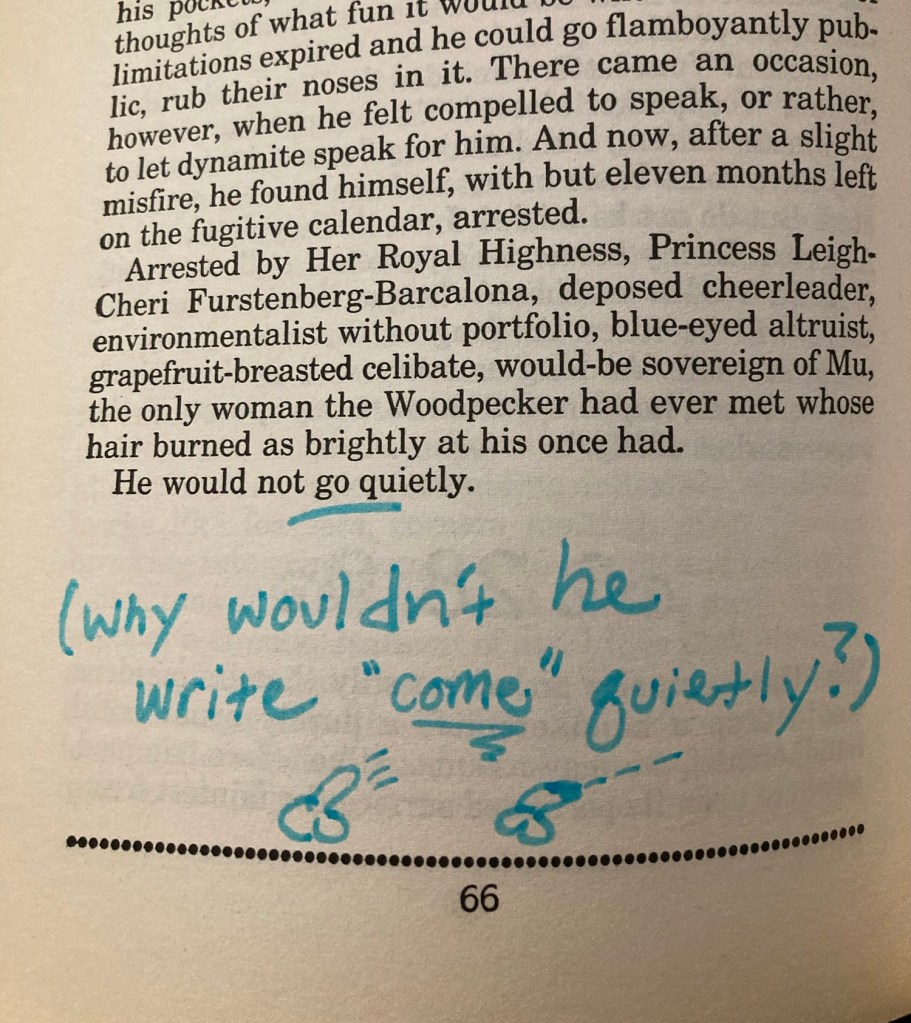
— Tom Robbins, Still Life With Woodpecker (1980) AKA the timeless tale of an exiled princess-turned-cheerleader, and the horny but well-meaning terrorist who explodes inside her, reducing her walls to smithereens. Oh, and by the way: this is the novel that indirectly coined the phrase “don’t yuck my yum.” Yeah, I agree: you DO need to read it. Right. . . Now.
If you couldn’t already tell, this magnificent excerpt comes from one of my all-time favorite novels, as intrinsic as anything else to my understanding of Love; but I ultimately decided it might be too vulgar to play well among the ceremony’s conservative crowd of lawyers and high-end government folk. Hence my perception of Love proving to be so niche, because the rest of the book boasts much more silliness and raunch, yet to me it will remain eternally the most romantic book in the entire world. That may seem the proclamation of an immature and hyperbolic simp, but I declare it with absolute certainty; that’s how intimately its story has embedded itself within me, my every aspect. Not only is it BY FAR the most passionate and fun read I’ve encountered in my life, somehow it’s also one of the wisest. For example, had I followed the advice within its pages, I probably would’ve stayed truer to myself at my brother’s wedding, not caring what anyone else thought of me; and in doing so, I could’ve saved myself that regret. (“Humanity has advanced, when it has advanced, not because it has been sober, responsible, and cautious, but because it has been playful, rebellious, and immature.”) Perhaps my tragically distant relationship with my family would also have advanced in this way, at least a smidgen, if I’d only allowed myself the room to be playful at this critical juncture; instead, I chose the safest route, which helped them understand me better exactly none.
For being such a raucous romp of a novel, though, it actually begins and ends on notes of cryptically vital Life-knowledge. Upon opening it, we’re hit with this hard-and-fastball: “Albert Camus wrote that the only serious question is whether to kill yourself or not. Tom Robbins wrote that the only serious question is whether time has a beginning and an end. Camus clearly got up on the wrong side of the bed, and Robbins must have forgotten to set the alarm. There is only one serious question. And that is: who knows how to make love stay? Answer me that and I will tell you whether or not to kill yourself.” Thankfully, the book departs from us on a much softer (though no less sagacious) note, more representative of its overall tone, when it tells us: “But I can and will remind you of two of the most important facts I know. (1.) Everything is part of it. (2.) It’s never too late to have a happy childhood.”
Mercifully, (and might I add: timely as Hell) for those of us who may find ourselves living under fascist or proto-fascist regimes, this book also includes lots of practical tips for understanding how we got here, messages of hope to aid you in coping, and/or passages that will recognize the pain you’re in, to make you feel seen: “… the truism that if we want a better world we will have to be better people came to be acknowledged, if not thoroughly understood, by a significantly large minority.” /// “Society had a crime problem. It hired cops to attack crime. Now society has a cop problem.” /// “Inessential insanities get one in trouble with oneself. Essential insanities get one in trouble with others. It’s always preferable to be in trouble with others. In fact, it may be essential. . . . Without the essential (intimate) insanities . . . behavior becomes predictable and therefore easy to control.” /// “… there are two kinds of people in this world: those who believe there are two kinds of people in this world and those who are smart enough to know better.” /// “What I’m saying is simply that every totalitarian society, no matter how strict, has had its underground.” Proceeding from that last point, Robbins goes on to educate and inspire us with the true story of Children of Paradise, Marcel Carné’s cinematic “celebration of the human spirit in all of its goofy, gentle, and grotesque guises,” which he (and hundreds of others!) filmed guerilla-style, illicitly, in the streets of Nazi-occupied France, “right under the Nazis’ noses . . . inside the belly of the beast.” Nearly a century later, it’s still capable of “moving audiences around the world.”
Here’s another huge piece of relevant education Robbins’ novel provides us with, which blows my mind even to this day, and which I never grow tired of explaining to people: “Equality is not in regarding different things similarly, equality is in regarding different things differently.” In other words, the fight for Equality lies not in seeking equal treatment, but in seeking equal respect and consideration. Presently, I cannot think of a more necessary distinction to make, nor a more necessary time in which to make it.
How is it possible that all these disparate elements exist within the same novel, at turns so lackadaisical then deathly serious? Incredibly, it contains so many wonderous pieces I’ve yet to even touch upon; like how the entire work is framed as a battle between an author and his temperamental typewriter; or how it touchingly retells the Frog-as-Prince fairytale, but as a prison communiqué. Even something as commonplace and presumably unassailable as The Calendar is not safe from Robbins’ incisive keystroke. Granted, I might be outrageously reaching here, but I assume that (by writing this line: “The moon invented natural rhythm. Civilization uninvented it.”) he was tacitly agreeing with my position that mankind would benefit from a reworked calendar of 13 months with 28 days each, thereby placing us in better sync with the cycle of our Moon. For all you Witchy Ones out there, he positively REVERES the moon here, in these pages. Additionally, he tackles the doldrums of despondence that Sunday seems to evoke in all of us, and he manages to articulate this phenomenon like nobody before or since. (“The busiest, loudest Sunday will always seem subdued next to the quietest Saturday. You go to paint the town red on a Sunday, you’d better be prepared for pink.” Elsewhere, more solemnly, he writes: “Sunday, a wan, stiff shadow of robust Saturday. Sunday, the day divorced fathers with ‘visitation’ rights take their children to the zoo. Sunday, forced leisure for folks who have no aptitude for leisure. Sunday, when the hangover knows no bounds. Sunday, the day the boyfriend didn’t come to the hospital. Sunday, an overfed white cat mewing hymns and farting footballs.”) Who else in human history has so reverently rendered the relentless restlessness of The Day of Rest?
Now, to bring this review(?) full-circle, let me leave you with some suggestions of Still Life With Woodpecker quotes that you could include in your own wedding vows, or in readings you deliver at other people’s weddings. 1.) “‘A better world has gotta start somewhere. Why not with you and me?'” 2.) “Love is private and primitive and a bit on the funky and frightening side.” 3.) “There are three lost continents,’ she lamented. ‘We are one: The Lovers.'” 4.) “What stood on the pyramids?” / “Souls. Souls like you and me. And we have to stand on them now. The pyramid is the bottom, and the top is us. The top is all of us. All of us who’re crazy enough and brave enough and in love enough. The pyramids were built as pedestals that the souls of the truly alive and the truly in love could stand upon and bark at the moon. And I believe that our souls, yours and mine, will stand together atop the pyramids forever.” 5.) “Funny how we think of romance as always involving two, when the romance of solitude can be ever so much more delicious and intense. Alone, the world offers itself freely to us. To be unmasked, it has no choice.” DISCLAIMER: THAT LAST ONE IS PARTIALLY A PARAPHRASED KAFKA, AND I INCLUDED IT ON THIS LIST MOSTLY FOR ALL MY FELLOW SINGLETONS OUT THERE, TO KEEP IN MIND WHEN VALENTINE’s DAY STRIKES LATER THIS WEEK.
Considering all that he’s meant to me, I’ve ingested distressingly little of Tom Robbins’ oeuvre. There are a couple of his titles burning a hole in my TBR pile (not to mention my actual, physical bookshelf,) but maybe I just don’t wanna take the chance that reading another of his novels will break his perfect streak for me. You see, both the books I’ve read by him (this one and Jitterbug Perfume) have earned exclusive 5-star status from me. And between the two of them, part of me feels like he taught me The Meaning of Life. Exhibit A, from Jitterbug Perfume: “A sense of humor, properly developed, is superior to any religion so far devised.” /// Exhibit B, from the novel at hand: “Wasn’t it made clear that civilization is not an end in itself but a theater or gymnasium in which the evolving individual finds facilities for practice?” Wasn’t it made clear, indeed. Thanks to you, my friend. Rest in peace.
Love always,
Mister L.

 Lonely Hearts Chapel
You must be logged in to post a comment.