Most. Romantic. Book. Ever.

This post is dedicated to Tom Robbins (1932 — 2025) Nearly a hundred years here, and we barely got to know you; so devoted you were, to helping us get to know ourselves. Thank you, my brother.

Once upon a time: I was meant to perform a reading at my brother’s second wedding, but true to form, I chickened out; luckily, my name never made it into the program anyway, because my brother possesses even worse follow-through than I do (if you can believe that.) Five years later I found myself tasked with performing another reading, this time for my second brother’s first wedding. Determined to prove how much I’d grown: this time, I REFUSED to chicken out! But the question nagged at me for months. What to read? An especially bedeviling predicament for someone like me, whose Idea of Love is (to put it generously, let’s say . . .) niche. Of course, my heart knew what I WANTED to read; it knew from the very moment I was asked. Eventually I would give up my heart’s desire and go with the tried and true Kahlil Gibran, although I’d like to believe I chose one of his not-quite-so cliché verses. But in a perfect world (absent of shame, and full of understanding,) my reading would’ve sounded like this instead:

“WHO KNOWS HOW TO MAKE LOVE STAY? 1.) Tell love you are going to Junior’s Deli on Flatbush Avenue in Brooklyn to pick up a cheesecake, and if love stays, it can have half. It will stay. 2.) Tell love you want a memento of it and obtain a lock of its hair. Burn the hair in a dime-store incense burner with yin/yang symbols on three sides. Face southwest. Talk fast over the burning hair in a convincingly exotic language. Remove the ashes of the burnt hair and use them to paint a mustache on your face. Find love. Tell it you are someone new. It will stay. 3.) Wake love up in the middle of the night. Tell it the world is on fire. Dash to the bedroom window and pee out of it. Casually return to bed and assure love that everything is going to be all right. Fall asleep. Love will be there in the morning.”

— Tom Robbins, Still Life With Woodpecker (1980) AKA the timeless tale of an exiled princess-turned-cheerleader, and the horny but well-meaning terrorist who explodes inside her, reducing her walls to smithereens. Oh, and by the way: this is the novel that indirectly coined the phrase “don’t yuck my yum.” Yeah, I agree: you DO need to read it. Right. . . Now.

If you couldn’t already tell, this magnificent excerpt comes from one of my all-time favorite novels, as intrinsic as anything else to my understanding of Love; but I ultimately decided it might be too vulgar to play well among the ceremony’s conservative crowd of lawyers and high-end government folk. Hence my perception of Love proving to be so niche, because the rest of the book boasts much more silliness and raunch, yet to me it will remain eternally the most romantic book in the entire world. That may seem the proclamation of an immature and hyperbolic simp, but I declare it with absolute certainty; that’s how intimately its story has embedded itself within me, my every aspect. Not only is it BY FAR the most passionate and fun read I’ve encountered in my life, somehow it’s also one of the wisest. For example, had I followed the advice within its pages, I probably would’ve stayed truer to myself at my brother’s wedding, not caring what anyone else thought of me; and in doing so, I could’ve saved myself that regret. (“Humanity has advanced, when it has advanced, not because it has been sober, responsible, and cautious, but because it has been playful, rebellious, and immature.”) Perhaps my tragically distant relationship with my family would also have advanced in this way, at least a smidgen, if I’d only allowed myself the room to be playful at this critical juncture; instead, I chose the safest route, which helped them understand me better exactly none.

For being such a raucous romp of a novel, though, it actually begins and ends on notes of cryptically vital Life-knowledge. Upon opening it, we’re hit with this hard-and-fastball: “Albert Camus wrote that the only serious question is whether to kill yourself or not. Tom Robbins wrote that the only serious question is whether time has a beginning and an end. Camus clearly got up on the wrong side of the bed, and Robbins must have forgotten to set the alarm. There is only one serious question. And that is: who knows how to make love stay? Answer me that and I will tell you whether or not to kill yourself.” Thankfully, the book departs from us on a much softer (though no less sagacious) note, more representative of its overall tone, when it tells us: “But I can and will remind you of two of the most important facts I know. (1.) Everything is part of it. (2.) It’s never too late to have a happy childhood.”

Mercifully, (and might I add: timely as Hell) for those of us who may find ourselves living under fascist or proto-fascist regimes, this book also includes lots of practical tips for understanding how we got here, messages of hope to aid you in coping, and/or passages that will recognize the pain you’re in, to make you feel seen: “… the truism that if we want a better world we will have to be better people came to be acknowledged, if not thoroughly understood, by a significantly large minority.” /// “Society had a crime problem. It hired cops to attack crime. Now society has a cop problem.” /// “Inessential insanities get one in trouble with oneself. Essential insanities get one in trouble with others. It’s always preferable to be in trouble with others. In fact, it may be essential. . . . Without the essential (intimate) insanities . . . behavior becomes predictable and therefore easy to control.” /// “… there are two kinds of people in this world: those who believe there are two kinds of people in this world and those who are smart enough to know better.” /// “What I’m saying is simply that every totalitarian society, no matter how strict, has had its underground.” Proceeding from that last point, Robbins goes on to educate and inspire us with the true story of Children of Paradise, Marcel Carné’s cinematic “celebration of the human spirit in all of its goofy, gentle, and grotesque guises,” which he (and hundreds of others!) filmed guerilla-style, illicitly, in the streets of Nazi-occupied France, “right under the Nazis’ noses . . . inside the belly of the beast.” Nearly a century later, it’s still capable of “moving audiences around the world.”

Here’s another huge piece of relevant education Robbins’ novel provides us with, which blows my mind even to this day, and which I never grow tired of explaining to people: “Equality is not in regarding different things similarly, equality is in regarding different things differently.” In other words, the fight for Equality lies not in seeking equal treatment, but in seeking equal respect and consideration. Presently, I cannot think of a more necessary distinction to make, nor a more necessary time in which to make it.

How is it possible that all these disparate elements exist within the same novel, at turns so lackadaisical then deathly serious? Incredibly, it contains so many wonderous pieces I’ve yet to even touch upon; like how the entire work is framed as a battle between an author and his temperamental typewriter; or how it touchingly retells the Frog-as-Prince fairytale, but as a prison communiqué. Even something as commonplace and presumably unassailable as The Calendar is not safe from Robbins’ incisive keystroke. Granted, I might be outrageously reaching here, but I assume that (by writing this line: “The moon invented natural rhythm. Civilization uninvented it.”) he was tacitly agreeing with my position that mankind would benefit from a reworked calendar of 13 months with 28 days each, thereby placing us in better sync with the cycle of our Moon. For all you Witchy Ones out there, he positively REVERES the moon here, in these pages. Additionally, he tackles the doldrums of despondence that Sunday seems to evoke in all of us, and he manages to articulate this phenomenon like nobody before or since. (“The busiest, loudest Sunday will always seem subdued next to the quietest Saturday. You go to paint the town red on a Sunday, you’d better be prepared for pink.” Elsewhere, more solemnly, he writes: “Sunday, a wan, stiff shadow of robust Saturday. Sunday, the day divorced fathers with ‘visitation’ rights take their children to the zoo. Sunday, forced leisure for folks who have no aptitude for leisure. Sunday, when the hangover knows no bounds. Sunday, the day the boyfriend didn’t come to the hospital. Sunday, an overfed white cat mewing hymns and farting footballs.”) Who else in human history has so reverently rendered the relentless restlessness of The Day of Rest?

Now, to bring this review(?) full-circle, let me leave you with some suggestions of Still Life With Woodpecker quotes that you could include in your own wedding vows, or in readings you deliver at other people’s weddings. 1.) “‘A better world has gotta start somewhere. Why not with you and me?'” 2.) “Love is private and primitive and a bit on the funky and frightening side.” 3.) “There are three lost continents,’ she lamented. ‘We are one: The Lovers.'” 4.) “What stood on the pyramids?” / “Souls. Souls like you and me. And we have to stand on them now. The pyramid is the bottom, and the top is us. The top is all of us. All of us who’re crazy enough and brave enough and in love enough. The pyramids were built as pedestals that the souls of the truly alive and the truly in love could stand upon and bark at the moon. And I believe that our souls, yours and mine, will stand together atop the pyramids forever.” 5.) “Funny how we think of romance as always involving two, when the romance of solitude can be ever so much more delicious and intense. Alone, the world offers itself freely to us. To be unmasked, it has no choice.” DISCLAIMER: THAT LAST ONE IS PARTIALLY A PARAPHRASED KAFKA, AND I INCLUDED IT ON THIS LIST MOSTLY FOR ALL MY FELLOW SINGLETONS OUT THERE, TO KEEP IN MIND WHEN VALENTINE’s DAY STRIKES LATER THIS WEEK.

Considering all that he’s meant to me, I’ve ingested distressingly little of Tom Robbins’ oeuvre. There are a couple of his titles burning a hole in my TBR pile (not to mention my actual, physical bookshelf,) but maybe I just don’t wanna take the chance that reading another of his novels will break his perfect streak for me. You see, both the books I’ve read by him (this one and Jitterbug Perfume) have earned exclusive 5-star status from me. And between the two of them, part of me feels like he taught me The Meaning of Life. Exhibit A, from Jitterbug Perfume: “A sense of humor, properly developed, is superior to any religion so far devised.” /// Exhibit B, from the novel at hand: “Wasn’t it made clear that civilization is not an end in itself but a theater or gymnasium in which the evolving individual finds facilities for practice?” Wasn’t it made clear, indeed. Thanks to you, my friend. Rest in peace.
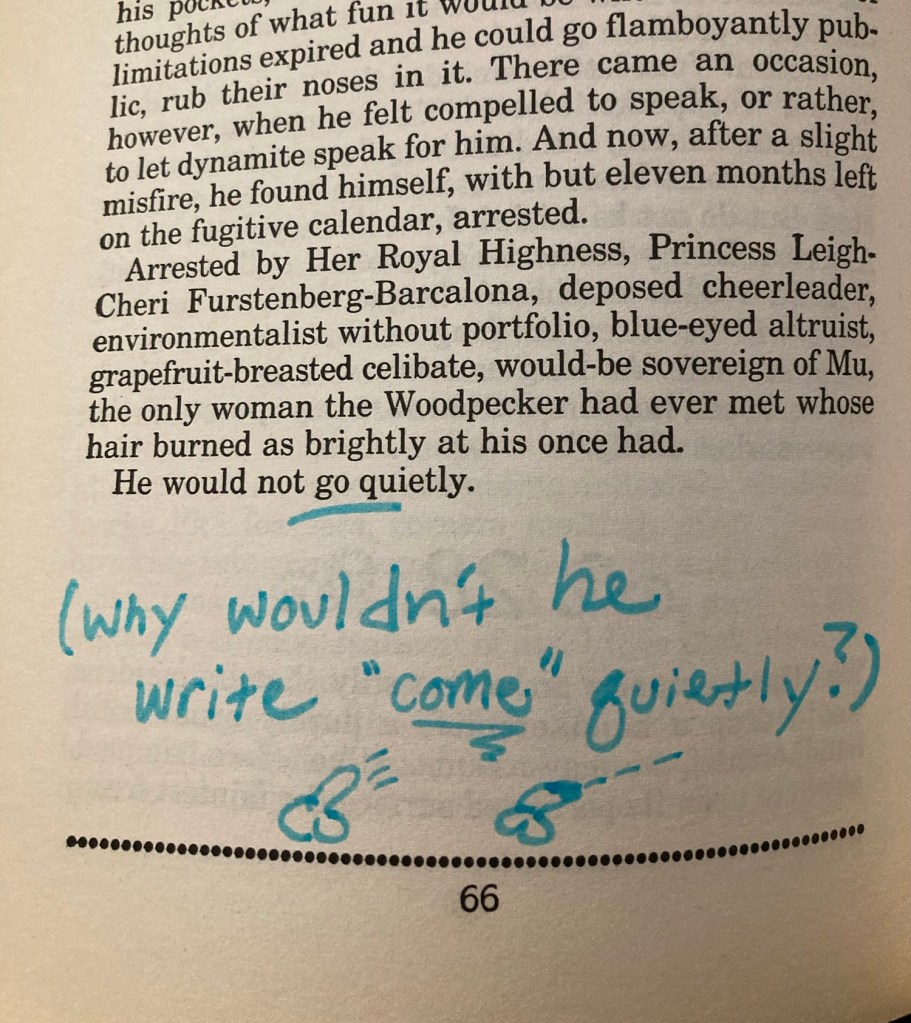
When you lend one of your favorite books out to someone you’re trying to flirt with. . . Oh well, I’d like to think Robbins would approve.

Love always,

Mister L.

“after my hands started bleeding”

Here’s an excerpt from Chapter 11 of LONELYHEARTS 2016, my upcoming campy, surreal, coming-of-age dramedy novel, about a bipolar pansexual at the end of the world. (More succinctly: it’s about a troubled young man who starts college during this era of American politics.)


Before me lay my most precious secret, literally written in stone for anyone to see.

And I was amazed at my ability to decorate the table so easily; without any trace of the self-hating perfectionism that usually haunted me, especially when I was working on anything visual or creative like this, anything that was going to be judged by its appearance. Whenever I worked on posters, or presentations or art-projects for school, I was prone to fits of howling violence, wherein I’d snap rulers and pencils in-half, and throw whatever instruments I’d tried and failed to shatter; and I’d also rip up cardboard, paper–anything tearable, really–sometimes even after my hands started bleeding; and in my worst outbursts, I would stab walls and furniture with the edges of the things I’d broken, then scratch them against my skin, to distract myself from the much deeper pain of beholding the ugliness of the imperfect thing I was creating.

But no; none of that tonight. Tonight, I turned away from my creation feeling sure it was a masterpiece. Tonight, I would fall asleep certain, for the first time in my life, that the day that was ending was done; that I’d done something to make the world a better place. I’d carved my truth into reality. I’d made it complete by sharing it. Indeed, my truth was now so complete that, even if it were rejected, there was a part of me that could not be changed.


This is one of the most cathartic things I’ve ever written. I hope you find some beauty in it, too!

You can read more excerpts, and soon the first 5 chapters, here.

Love always,

your Mister

My Birthday for a Book

Hello there, Stranger.

It’s been a while since I’ve let myself reach out to you. I’ve missed you more than I can describe; but, for many months now, I’ve avoided all social media. And it felt amazing, after a while. But it’s time for me to learn how to strike a balance between sharing and living. Even as I type this, I check my phone several times. Maybe this is a mistake? but I have plenty of new writings I want to share, so: onward!

Today is an especially powerful date for me, because it’s the birthday of my soul-mate /

miss l

Looks good for 85, right? You can tell we’ve been through a lot together.

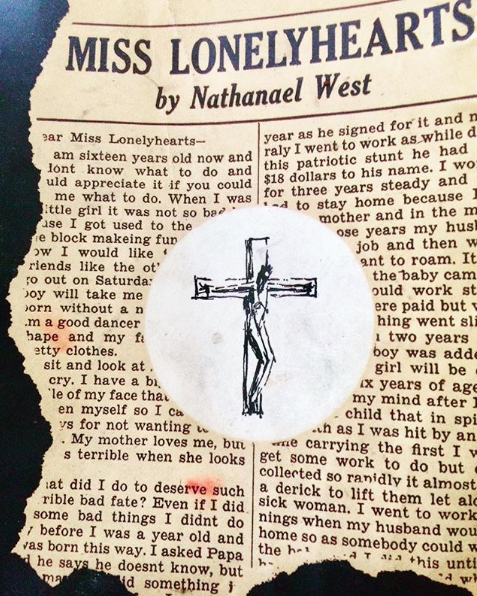
my favorite book of all-time: Miss Lonelyhearts! It was published 85 years ago today; then, almost immediately, the book became the victim of the very Depression it portrayed, and Miss Lonelyhearts’ publisher went bankrupt. And that’s why it’s now one of the greatest books you’ve probably never heard of, but one you MUST! READ! because it’s more relevant today than it’s ever been. (Plus, once you read it, I can finally talk about it with someone! And psssst. . . You can read it online. But, you’ll probably end up loving it, then eventually own four or five copies like me.)

I first read this book (for free online) about four years ago; and it instantly became an inspiring obsession of mine, and remains for me a deeply moving and comforting experience. I carried it around like a bible for years, and lent it to more people than I can remember. For the last few years, I’ve also been working on a novel of my own, based on Miss Lonelyhearts. 230-plus pages later, I am tantalizingly close to being done with the first draft. Anyhow: I wrote a poem to commemorate Miss Lonelyhearts’ birthday!

Birthstone

The weight of my soul
is the diamond untarnished
by noise and touchings
and other incomplete
sensations. It is the phantom
singularity that pulls and swirls
my insides, even when a favorite
song does not distract me, or
a movie isn’t what I thought.
The thing that I was born with
that’s different but the same
in everyone else: it soothes
me and says to me wordlessly
that everyone dreads being
exactly what they are:
an average human being,
who avoids what they want most,
and says things they don’t really believe
just to feel powerful or belonging.
But, despite its vast logic
and miracles, it can’t stop me
from killing myself,
because it holds no opinions
or context of death. Something else
overpowers me, and forces me
to live, something multiplied
freshly each moment,
decorating all that’s come before.


You’ll be hearing from me again soon. I promise!

I hope I get to hear from you someday, too.

Love always,

your Mister

“entire sweating restless world”

Excerpt(s) from Chapter 9 of  LONELYHEARTS 2016, my upcoming campy, surrealish, dramedy novel about a bipolar pansexual at the end of the world. (More succinctly: about a troubled young man who starts college during this era of American politics.)


The door was unlocked. Judging from the smell, it’d been left unlocked for a drug-dealer or two. A pungent mixture saturated the air and devoured me as I crept within; entranced. It was like I was floating on his sweat-glands, swimming through his bladder. Climbing his swollen, throbbing intestines. My lips parted so I could taste the flatulent agony, the stagnant waste and recycled air that I recognized from my own life: he hadn’t left his room in days, maybe even weeks.

(. . .)

I’d never felt closer to him, entangled there with his un-showered body. Under sodden, warmly chilling sheets, with crumbs of god-knows-what sticking to my skin. I became possessed with an overwhelming need to lick him clean, to grind my tongue across every pore, valley and bulge of his flesh until I cleansed him of his depression. I would take him into my mouth and hold him inside, bathing him there forever if I had to, if it meant I could lick and suck all his stains away: the lifetime of stains left by selfish parents, thoughtless friends, uncaring strangers, unexamined pain and unexpressed passion. I smelled myself in his unrepentant sloth; saw myself in his dewy-jungle armpit; tasted myself in his salty sadness; heard myself in his near-but-faraway heartbeat. Felt myself, in his struggling to be held. He was me, born into a different body. I was in bed with the entire sweating restless world.

You can read more excerpts (and soon, the first five chapters) here.

Love always,

real cover

tentative cover

your Mister

“a gun on every table”

Excerpt from Chapter 8 of LONELYHEARTS 2016, my upcoming campy, surrealish, dramedy novel about a bipolar pansexual at the end of the world. (More succinctly: about a troubled young man who starts college during this era of American politics.)

(In this scene: Miss Lonelyhearts finally–at his friend’s insistence–gives in and watches Trump’s “hilarious” candidacy announcement.)


My laughter persisted while I fished for cig number four. Okay. This wasn’t so bad after all; mostly just loud and bloated incoherence. A desperate, dying man, who’d never truly grown an ounce in his life. Because he was given money instead of love or guidance. Just like I’d expected. I laughed because I needed to; it made me feel like I wasn’t afraid of him. Like I wasn’t afraid of what he was bringing-out in people. As long as I laughed, he would just be some spoiled little rich boy who could never really hurt me; because he’d probably cheated and bought his way through school, and eventually through life. Whereas I had struggled. And was forced to learn.

Now he was telling the audience not to believe the Bureau of Labor Statistics; he insisted the ‘real’ unemployment rate was three or four times what they said it was. I laughed even harder; who was THIS fucking maniac, to tell people what to believe?

Then he mentioned nuclear weapons, and the laughter stopped. I became a homeless orphan as the whole world burned and I lost all feeling. People and their buildings unknowingly melted into shadows all around me. Survivors developed the beginnings of the cancer that would rot their grandchildren’s insides. Centuries passed, and poisoned people grew poisoned things from poisoned earth. Humanity died without living.

OUCH. I flicked the filter out the window without looking, then lifted the burnt flesh to my mouth, to suck and lick the warmth–at first, to soothe the burn; but I gradually became aroused by the salty, pulsing soot of my fingers. So I closed my eyes and pressed my face against it. And slid my tongue in it. All was probing, reactionary dampness.

Hot water spilled onto my chest, causing me to re-enter the moment with a full-body jerk. Panicked, I braced my laptop, then heaved a relieving sigh at its safety. Was I crying? or were my eyes just irritated? I reached for another cigarette as I heard him, and remembered where I was.

Well, you need somebody, because politicians are all talk, no action. Nothing’s gonna get done. They will not bring us–believe me–to the Promised Land. They will not. . . I will be the greatest jobs president that god ever created.

I chain-smoked with blurry eyes as I continued to watch Trump’s ramble: comparing politics to football, saying he was ‘really rich,’ and then apparently trying to say ‘braggadocious’ before giving up and deciding it was too ambitious of a word for him. I allowed myself to chuckle at his incompetence, even though I knew the world was ending. He rambled through some more nonsense, before circling back to his favorite topic: his wealth.

nobody knows what I’m worth. And the one thing is that when you run, you have to announce and certify to all sorts of governmental authorities your net worth. So I said, ‘That’s OK.’ I’m proud of my net worth.

This led him to an exhaustive listing of his business dealings and their estimated worth; but he assured the audience he wasn’t doing it to brag:

I don’t HAVE to brag,’ he bragged.

He transitioned clumsily into saying he would build a wall between America and Mexico (and somehow make Mexico pay for it?) And then he promised to protect Americans’ guns. Not their families, just their guns. Guns were the only one of the two he mentioned protecting, anyway. In fact: every time he’d said the word ‘family’ at all during the speech, he was only referring to his own. Just to name them, to say how ‘great’ they were, and how ‘proud’ he was. Only once did he notably mention being inspired by an American citizen that wasn’t blood-related to him. He talked of a nameless woman: someone he’d seen on TV, talking about a local crime, whom he then felt compelled to call: ‘and she said, ‘You know, Mr. Trump, I was always against guns. I didn’t want guns. And now, since this happened . . . We now have a gun on every table.

‘‘We’re ready to start shooting,’’ this terrified woman told Trump, to which he replied: ‘Very interesting.

Not too bad, I told myself; just typical dictator shit.


Read more excerpts (and soon, the first five chapters) here

Love always,

your Mister

“first to dream of immortality”

Excerpt from Chapter 7 of LONELYHEARTS 2016, my upcoming campy, surrealish, dramedy novel about a bipolar pansexual at the end of the world. (More succinctly: about a troubled young man who starts college during this era of American politics.)

(In this scene: Miss Lonelyhearts tries to make things work with a man he met online, who looks a lot like his ex, “The Bow-Tie.”)


He poured me another glass of wine and asked about something he’d seen on my profile. The website prompted you to answer questions so it could calculate your compatibility with people. (Ours was 63%.) Once you answered a certain question, you could see everyone else’s answer to the same question. One question asked: ‘What is your main motivation in life? A.) Love; B.) Success; C.) Family,’ and I forget the last option. He’d seen that I chose ‘Love,’ and asked me why. I’d also seen that he chose ‘Success,’ but I wasn’t planning on saying anything about it.

I told him that I didn’t mean romantic love necessarily, that I meant it more as a spiritual force. I admitted it was something I didn’t have a clear idea of yet, then brandished my phone to look up some facts and build a case for myself:

‘It’s like Sinclair Lewis wrote: ‘[Love] is the morning and the evening star!’ Well . . . okay, so, he was paraphrasing Robert Ingersoll, who went on to say . . . ‘[Love] was the first to dream of immortality’ . . . So, yeah, I just don’t think I’ve ever really felt that before, ya know?’

Thankfully, he wasn’t listening. As soon as I stopped rambling, he informed me why he chose ‘Success.’ He’d been groomed to take over his father’s insurance firm, and was already an intern there. His answer implied that ‘Success’ had been chosen for him.

On the way back to the garage, we passed a man on the sidewalk who was likely homeless. He asked for money or food. My date continued walking a few paces away from me, but then noticed my arm was no longer holding his. He saw me give my leftovers to the homeless man, and immediately began screaming at me. His anger echoed and people stared. He bought that food for ME to enjoy, he yelled, ‘not some lazy fuck.’

‘GET A FUCKING JOB!’ he screamed at the man, who weakly offered the box back to us, which only made my date angrier. ‘LIKE WE’RE GONNA FUCKING EAT IT AFTER YOUUU TOUCHED IT!’

I managed to wrap myself around him from behind and calm him down. I kept repeating ‘I’m sorry, baby, it’s all my fault; I’m sorry, baby’ while kissing and rubbing him. At the time, I was oddly touched that he cared so much about it; but looking back, I think he was only so upset because I would’ve felt a stronger responsibility to sleep with him if I’d eaten the leftovers of what he bought. That’s also probably why he’d been so generous with the wine.


Read more excerpts (and soon, the first five chapters) here.

Love always,

real cover

your Mister

“every wet stranger”

Excerpt from Chapter 6 of LONELYHEARTS 2016, my upcoming campy, surrealish, coming-of-age dramedy novel about a bipolar pansexual at the end of the world.

(In this scene: I use my own hometown as inspiration to delve into the psychology behind Trumpism. Please let me know how you think I did!)


I recognized his bow-tie. Why did I recognize that bow-tie?

‘I just didn’t think our conversation was finished. From earlier . . .’

Oh yeah! He was the guy from my morning-class. I’d forgotten about our debate; the memory had sunken into the murk of the day. But it was definitely him, the guy from the class where we’d discussed welfare reform.

I’d argued that welfare was a waste, that it ‘makes people lazy, and it’s too easy to take advantage of.’ I passionately believed these things because I had been taught them. I was still possessed by the politics of my hometown. I’d been taught and surrounded by under-educated and under-represented people my entire life. Furthermore, I’d been taught and surrounded by lower- and lower-middle-class people, who’d been taught to be ashamed of themselves. But they’d also been taught to be too proud to ever admit that they’re ashamed, or that they need help.

They channeled the anxiety of these contradictions into blame. They blamed people who were poorer than them, and they blamed people who were richer than them; but they blamed the richer a little bit less, though, because they admired those people and wanted–more than anything else–to be them. And they never blamed people in similar circumstances as themselves, because that would welcome the possibility that they themselves could also be blamed.

They believed the world was at fault for all their failures, but their successes were theirs and theirs alone. I believed this, too. I called myself a ‘rugged individualist,’ which was a term I’d heard in History class when I was younger. I remembered that a President had coined the term, but I’d forgotten the exact context of it. It meant that I believed everyone was responsible for solving their own problems, no matter what caused them.

That’s why I argued with The Bow-Tie in class earlier, after he asserted that welfare programs ‘are good investments for any society.’ He said that such programs made the world safer, because they helped provide sustenance, education, and healthcare for people–and especially children–who would otherwise be powerless, malnourished, and desperate.

After he said this, I lazily reached into my bag and brandished my umbrella. I explained that I carried an umbrella with me everywhere, no matter the weather.

‘So, when it rains,’ I said, ‘I’m ready. I like to say that it’s my Northeastern blood; expect the unexpected. I’m not going to walk up to someone who wasn’t prepared and just hand them my umbrella. I’m going to expect them to figure it out for themselves.’

‘But what about people who can’t afford umbrellas?’ he asked.

‘Oh! So every wet stranger is my responsibility?’

‘The world is everyone’s responsibility.’

I sniggered and dismissed his point with a sharp wave of my hand. I didn’t feel like expending the effort of finding words to rebut him. Which was probably why he was sitting down on the bench next to me, claiming our discussion wasn’t finished. Damn him. And damn his perceptiveness . . . that gorgeous perceptiveness.


Read more excerpts (and soon, the first five chapters) here.

Love always,

real cover

Be gentle; this is only a tentative cover.

your Mister

“the mess that’s America”

Excerpt from Chapter 5 of LONELYHEARTS 2016, my upcoming campy, surrealish, coming-of-age dramedy novel about a bipolar pansexual at the end of the world.


Dead Eyes shrugged in response. He had no idea what would make him sad because he had no idea what would make him happy. His malaise was the product of a common and dangerous mixture: selfishness and self-unawareness.

‘I’m obsessed with the mess that’s America!’–another Marina & The Diamonds song was blaring from the car’s speakers–‘I’m obsessed with the mess that’s Amer-i-ca-a-a!’ I was so happy that Dead Eyes liked her music. She was one of my favorite artists, and he often heard me listening to her, so he’d built up a quick tolerance to (and eventual appreciation of) her work.

I was honestly so overjoyed just to be in the car with him. That was the first time he ever allowed it, since we were traveling a few hours away for the concert. There was no chance of seeing anyone we knew out there; plus, I think he was secretly taking the risk just because he’d grown to love Marina & The Diamonds’ music so much. He never specifically asked me to play it, but he’d stopped complaining whenever I played it around him; and that was HUGE.

I reached for his hand, like I imagined a wife would do if her husband was driving. He swatted my hand away the moment it touched him; I was finishing one of my annoying rambles when he swatted and interrupted me:

‘It’s not like I’m saying one is more TALENTED than the other or anything, because all that stuff’s subjective anyway. I’m just saying that I’m a little more attracted to Marina’s movement because SHE calls her fans ‘Diamonds,’ whereas Lady Gaga calls HER fans ‘Monsters.’ And I GET that both names are powerful images, and they’re both about being confident, and proud of what makes us different, but–I don’t know–the Diamond’s just a much more comforting image to me . . . It’s my birthstone, you know–’

That’s when he swatted me, and said:

‘I still don’t get why you’re dressed like that.’

Dead Eyes wasn’t happy that I was dressed as Marina; specifically, in the outfit she wore during the closing of the concert we were about to see. I actually just think he was upset that I was dressed femininely. I matched everything to her outfit as best I could, and I even got a convincing wig; but I couldn’t afford shoes as outrageous as hers, so I was wearing my faded sneakers. All night I’d been earnestly hoping that the rest of my outfit would make up for the ugliness and poverty of my feet. I looked down at my rugged shoes with the worn soles; and I sighed, remembering a variation of what I heard girls in my grade say all the time: ‘If you wanna check if a guy is gay, just look at his shoes. They always have nice shoes. A gay guy would KILL HIMSELF if he had to wear dirty straight-guy shoes.’

I tried to grab his hand again, this time more tenderly, but he yelled at me to stop bugging him. I wanted to play his wife in the car with him; I wanted to be a family. But we’d both been taught that when a man falls in love with a woman, he marries her; and we’d both also learned, from whispers and obscene jokes, that some men liked to have sex with other men, and those men could never marry.

I found myself praying, for the first time in my life. I was praying to nothing and no one in particular; I prayed for all the people who’d taught us; for everybody like them; and for all the people they’d ever taught: I prayed that none of them would ever stop learning.

But I guess it was enough for me that he and I were just going to a concert together. I wasn’t sure if I loved him, but he’d definitely become a habit of mine–just like Marina’s music. I couldn’t remember a single day when I didn’t listen to at least five Marina songs. I always told people: ‘Marina & The Diamonds is the closest thing that I have to religious beliefs,’ and that phrase still feels true today, even in memory.

When we walked into the venue, a group of rowdy people yelled at us from the mosh-pit: ‘MARINA! MARINA’S HERE, EVERYBODY! LOOK, MARINA’S HERE!’ But they were most likely just making fun of me for dressing up like her.


Read more excerpts (and soon, the first five chapters) here.

real cover

Be gentle; this is only a tentative cover.

Love always,

your Mister

“something he thought was happiness”

Excerpt from Chapter 4 of LONELYHEARTS 2016, my upcoming campy, surrealish, coming-of-age dramedy novel about a bipolar pansexual at the end of the world.

(…in which we meet a character known as Dead Eyes, “so-called because of his almost-black brown eyes and vacant stare. I assumed it was because he was stoned all the time, which he was, but he hid it well. He had the same vacant stare even when sober. It was just his personality. People called him Dead Eyes as a term of endearment, though; not of ridicule. All the girls at school seemed to think it was sexy. And honestly, they were right. There was something about his way of looking right-through you that made you more desperate than ever to be noticed.”)


During our visits, he always poured himself a few small glasses of his parents’ scotch. Whenever he accidentally ingested a large amount, he would pour a little water into the bottle to raise the liquid level and make his thievery less obvious. His parents rarely spoke to each other anymore, and they slept in separate bedrooms; so if they noticed some scotch was gone, they would probably just assume the other drank it.

His parents’ lack of communication, with each other and with him, had become important pieces of something he thought was happiness. Whenever his parents left him alone, he would come alive by deadening himself. With booze, cigarettes, weed. He would usually offer me some–‘to loosen you up,’ he would say–but I would usually decline all but the occasional dainty sip of scotch. ‘Such a pussy,’ he would always laugh at me, and I would respond by giggling an ‘I know, I’m sorry’ before pulling him into a rough and wet kiss to distract from my uncoolness.

I often found myself distracting him with flirtation because we didn’t share a lot of interests or opinions. Even if we did, he probably wouldn’t have enjoyed discussing them. I said once that I thought his parents sleeping in separate rooms was oddly romantic; then I blushed and touched him, and I admitted that it reminded me of the type of togetherness he and I shared; I said, whenever I got married, I would need to have a separate bedroom / office of my own, where I could retire without waking my spouse on the nights I stayed up late.

He said it was ‘fucked up’ that I’d want separate bedrooms.

I asked him if he ever thought about being married someday, and he said it bummed him out to think about that. He said he’d need to marry a woman, so they probably wouldn’t have sex much because he wouldn’t ‘be that into it.’

I asked why he watched porn of women if they didn’t turn him on, and he said it was different with porn because he could almost imagine that it was a guy doing all the things the girl-on-screen was doing.

Plus, he said it’d be too hard to remember to delete his Internet browsing history every single time, like he’d need to do if he watched gay porn; just in case his parents ever snooped on his computer.

When he said that, I remembered a slogan that I’d seen every day on the door of my first-grade classroom; in big block letters, it read: EVERY CHILD IS A STORY WAITING TO BE TOLD. And then I thought about Dead Eyes’ parents, and how they treated him more like a letter they were writing: to distant relatives, to friends from college, to members of their church. He was somebody else’s letter instead of his own story, and I was sad for him. He ‘couldn’t’ be gay and still have parents, because that would disappoint them too much. Back when he joined the basketball team (instead of football, which his father played,) his parents’ reactions made it clear to him that such a disappointment was the biggest kind they could tolerate while still supporting him, emotionally et cetera.

I often wondered if his parents would’ve been proud to know that their son was addicted to the same scotch as they were.


Read more excerpts (and soon, the first five chapters) here.

real cover

Be gentle; this is only a tentative cover.

Love always,

your Mister

“sexual frustrations of other men”

Excerpt from Chapter 3 of LONELYHEARTS 2016, my upcoming campy, surrealish, coming-of-age dramedy novel about a bipolar pansexual at the end of the world.


It should come as no surprise that, after the news of my kiss with Father spread, people–especially other boys and men–began acting more strangely than usual around me. One of the strangest such moments occurred in the boys’ restroom with a boy I call The Lamb. (I forget his name now, but he was a football player whose platinum curls always struck me as lamb-like. Football wasn’t in season, and a half-year without practices had faded his autumnal tan. His fleece was white as snow; and everywhere his teammates went, he was sure to go.)

I was standing at the urinal, attempting to relieve myself. But my mind kept drifting to the thought of how barbaric urinals are; they provide almost no privacy for the private function they serve. The stream had just begun when The Lamb strolled in and sidled to the urinal next to me. He was taller than me, but he never seemed to look down on me; he was taller than most people, actually, yet he seemed to look up to everyone. My stream was dripping to a stop, but The Lamb’s hadn’t even started. He had only unzipped. I could feel his stiff uneasiness next to me but didn’t think anything of it.

I shifted to begin zipping and walking toward the sink, but he leaned down and pressed his face into mine; our lips met. It was sudden, but the moist warmth glued me firmly to the moment. I relaxed into his nervousness. I wrapped my arms around his body and pulled him into mine. Our manhoods touched, then his eyes shot open as he jumped backward. I saw a brief sun-like glimmer in his sky-blue eyes; I swore it was shining from the inside, even though I logically knew it must be the reflection of outside light against his eye. The sparkle almost made me believe in souls, but he quickly bowed his head in shame, zipped up, and scurried away without a word.

I stood there with my manhood exposed, inhaling and swallowing the truth that much of my life had been and would be shaped by the sexual frustrations of other men; this revelation tasted of sweetness but smelled of urine and disinfectant.


Read more excerpts (and soon, the first five chapters) here.

real cover

Be gentle; this is only a tentative cover.

Love always,

your Mister

Previous Older Entries

my last drink

November 21, 2021
1492 days ago.

Enter your email address to subscribe to this blog and receive notifications of new posts by email.

Join 95 other subscribers